
Introduction
Community-based research is often judged by the easiest numbers to count: surveys completed, meetings held and reports published. These figures show what a project did, but not whether it changed anything for the people it aimed to help.
In community-based research, the harder question is whether research helps a community make better decisions, build capacity and sustain progress after a grant or study ends. Answering it takes a longer view—one that tracks not just outputs, but also changes in relationships, policy and access to resources.
Evaluating local sustainable development is like keeping score in a game where the rules and the score itself are disputed. A credible evaluation shows who makes decisions, whose priorities count and whether gains last beyond the final presentation.
Analysis of the teams and players
The first group is the community: residents, local organizations, service users and informal leaders. Community-based research treats them as more than participants recruited to provide data. Their knowledge helps define the problem, clarify what change should look like and reveal consequences an outside research team might miss.
Researchers and institutions bring methodological skills, time and access to evidence. In community-based research, strong research partnerships do not ask residents for their insights while leaving control of the questions, interpretation and publication to others. Instead, they share authority at each stage and make that arrangement clear.
Local government, schools, health providers and other organizations make up a third group. In community-based research, these organizations matter because they may control the budgets, services or rules that determine whether findings lead to action. Their involvement can help turn evidence into practice, but institutional priorities can also overshadow goals set by the community.
Partnerships should therefore be assessed not just by who signed an agreement, but by who had influence. Evaluators can ask who set the agenda and interpreted the results, whether disagreements were recorded, and whether community members were paid and credited. These details help explain why an intervention succeeds, stalls or loses trust.
Key factors
For community-based research, start by establishing a baseline. If a project aims to improve access to healthy food, for example, it should define what access means locally. Distance, affordability, opening hours and cultural suitability may all matter. Without a clear starting point and a shared definition, later comparisons may make a project look successful without reflecting people’s experience.
Impact measurement in community-based research should connect different layers of change. Immediate outputs might include a community-led needs assessment or a new referral process. Intermediate outcomes could be better coordination between services or more resident influence over planning. Longer-term effects, such as improved wellbeing or fairer access, are harder to attribute to a single project.
Communities change for many reasons, including new public funding and economic shocks. A research project rarely controls them all. Evaluation should distinguish contribution from attribution: show how the work may have helped, consider other explanations and avoid treating correlation as proof that the project alone caused a change.
Participatory methods can strengthen the evaluation when used thoughtfully and are central to community-based research. Residents might help choose indicators, interpret survey responses or conduct interviews in settings where people feel comfortable speaking. But participation is not automatically empowering. Token consultation, unclear consent or unpaid work can reinforce the very imbalances a project aims to address.
Useful measures combine numbers and personal accounts. Counts of service use may show whether more people joined a program, while interviews can explain why others stayed away. Breaking results down by age, income, disability or neighborhood can reveal uneven gains hidden by an overall average. Collect data only when it has a clear purpose and can be handled safely.
SDG indicators provide a common language for linking local work to broader sustainability goals, but they need to be adapted to local circumstances. A city-level measure may not show whether a neighborhood feels safer or whether residents have a real say in land-use decisions. Global frameworks can help organize questions, but they cannot replace evidence defined by the community.
Time matters, too. Some outcomes appear within months; trust, institutional practices and environmental resilience may take years to change. A sound evaluation sets short-, medium- and long-term checkpoints, tracks progress and revises its theory of change when the evidence does not match the plan.
Finally, the people who generated the knowledge should benefit from the findings. Share results in accessible formats and make their limits and uncertainties clear. When residents can see how their evidence informed a decision—or why a recommendation was not adopted—the process is more accountable than a report left in an institutional archive.
Match scenario
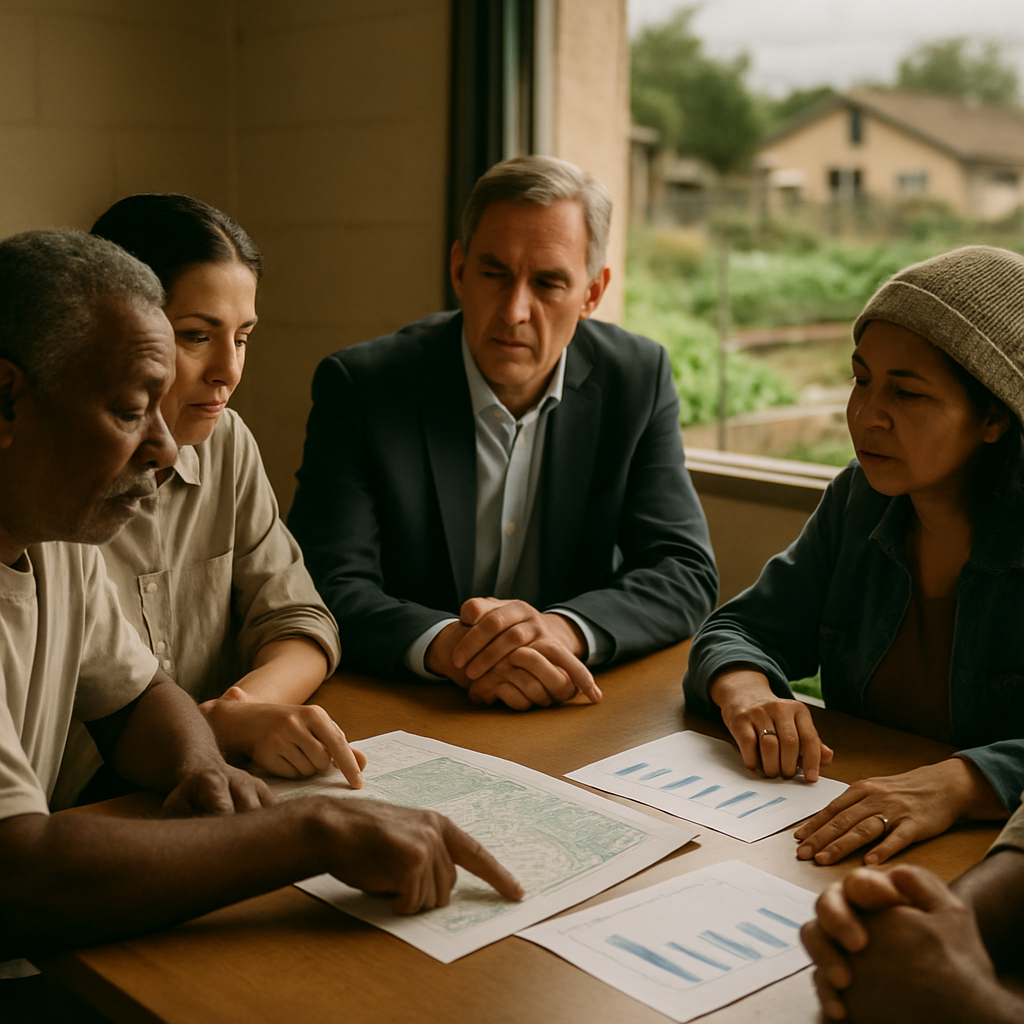
Imagine a neighborhood research team investigating heat risk. This community-based research project brings residents, researchers and local organizations together to map areas with little shade, identify the groups most exposed and combine local observations with temperature data. The team starts with a practical question: which decisions could this evidence change?
First, the team records baseline conditions and agrees on indicators: access to shaded public spaces, residents’ experience of heat and whether local plans reflect neighborhood priorities. It also tracks who takes part, who is missing and how decisions are made. This creates a starting point, not a claim of success.
Next, the team checks whether the evidence leads to action. Did the municipality change a plan, allocate resources or explain why it did not? Did community members gain skills or lasting influence? Follow-up interviews and decision records can show progress that a single temperature reading cannot. Even if conditions improve, the evaluation asks what else contributed and who benefited.
Several outcomes are possible. A project may produce strong evidence but face institutional resistance. It may lead to a policy change that is implemented unevenly, or build community capacity before environmental conditions improve. A good assessment treats these as distinct results instead of forcing every story into a simple win-or-loss narrative.
Conclusion
The value of community-based research lies not in the volume of data collected, but in the changes it helps make possible. That means tracking outcomes while also examining power, process, unintended effects and whether local capacity lasts.
Researchers alone cannot decide how to measure progress toward sustainable development. The final assessment should test evidence against community priorities and follow decisions over time. When measurement is shared, transparent and proportionate to the claims made, research can do more than document local change: it can help make that change accountable.