
The Climate Adaptation Match Is Won by Listening
Introduction
Climate adaptation is often framed as a race against time: water levels are rising, dry spells are lasting longer, heat is intensifying, and infrastructure was built for a different climate. But success also depends on information. Plans based only on satellite data and engineering models can overlook what residents already know: where water flows, which slopes are most likely to fail, and how the landscape changes through the year.
Indigenous knowledge and local expertise can sharpen risk assessments, reveal blind spots and make plans more practical. They should not be treated as anecdotes added to a technical plan, or as a source of free labour. The challenge is to include this knowledge in decisions without extracting it or romanticising it. Respecting indigenous knowledge also means recognising the rights and responsibilities of the people who hold it.
Traditional knowledge is more than a collection of observations. It can be passed down through generations and shaped by relationships with particular places. That does not make it automatically correct or uniform. Planners need to understand how the knowledge was formed, who holds it and what is needed to use it responsibly. Indigenous knowledge may include observations, values and practices that are meaningful only within a specific cultural and environmental context.
Analysis of teams or players
Adaptation planning brings together groups with different perspectives. Government agencies provide budgets, legal authority and technical standards. Researchers contribute models and scenario analysis. Local organisations and residents bring detailed knowledge of daily risks, livelihoods and past interventions. Indigenous knowledge can help explain how those risks have shifted over time and how earlier decisions affected the community.
Often, the imbalance is clear from the start. Institutions control the agenda, data formats and funding, while communities are asked to comment after priorities have been set. It is like asking a team to play after its opponent has chosen the rules, venue and tactics.
Community-led planning changes this dynamic. Residents help define the problem, choose options and decide what success looks like, rather than simply approving a finished proposal. But no community speaks with one voice. Age, gender, livelihood, land rights and social status can all affect whose experience is heard. Making room for different perspectives is essential when working with indigenous knowledge.
Planners should treat indigenous knowledge as diverse and changing, not as a single inherited playbook. A farmer, fisher, herder and village elder may describe different risks because they experience the same environment in different ways. These differences can show where a plan protects one group while exposing another to greater risk. Indigenous knowledge should be understood through dialogue with its holders, not reduced to a set of generic claims.
Scientific analysis and local experience are most useful when they inform and challenge each other. A model may estimate flood depth across a wide area; residents may point out a blocked channel, an evacuation route that becomes impassable, or a building used as a refuge. The model provides scale, while local knowledge adds detail. Planners need to find ways to test both, including specific insights drawn from indigenous knowledge.
Key factors
Timing matters. If communities are consulted only after a project is designed, their knowledge may become a final checklist with little influence over spending or construction. Involving local knowledge holders from the outset can change the questions being asked and prevent costly plans from addressing the wrong problem. Early engagement also gives indigenous knowledge holders more say in how their contributions are interpreted.
Trust is built through the process, not promised in a meeting. People need to know what information is being collected, who will see it, whether it will be published and how it might affect land, livelihoods or cultural responsibilities. Consent should be informed and ongoing, especially when knowledge is sensitive and should not be mapped or shared publicly. These safeguards help ensure indigenous knowledge is used on terms set with the people who hold it.
Evidence also matters. Traditional practices may help manage water, crops, forests or housing, but they are not automatically effective under rapidly changing conditions. A strong approach tests options against current risks, combines relevant methods with scientific monitoring and revises decisions when the evidence changes. Such evaluation can strengthen climate adaptation while respecting the origins of indigenous knowledge.
This is no reason to dismiss knowledge that does not fit a model. Instead, planners should compare evidence transparently: what was observed, by whom, over what period and under what conditions? If disagreements remain, they should be recorded and explained, with a clear way to review the decision rather than forcing consensus.
Local expertise also needs the means to make a difference. Residents may understand a hazard but lack the funding, legal authority or technical support to address it. Adaptation budgets should cover participation, implementation and long-term maintenance, not just reports and consultation events. Supporting local expertise in this way can help communities put resilience strategies into practice.
Accountability must work both ways. Institutions should explain how community input changed a plan, what was not adopted and why, and who will monitor the results. Without that feedback, participation can become a performance: people share information, officials keep control, and no one knows whether the process improved safety.
Match scenario
Consider a hypothetical coastal district facing heavier rainfall and more frequent tidal flooding. Engineers propose a drainage system based on elevation data and rainfall projections. Residents point out that water repeatedly backs up at a narrow crossing and that the usual route to higher ground becomes unusable at high tide. Indigenous knowledge of past floods could also help planners understand how these hazards have changed across generations.
An initial plan might focus on pipes and pumps. A stronger one would bring residents, engineers and emergency managers together to map how and when water moves, identify vulnerable homes and test several options. These might include drainage upgrades, protected access routes, wetland restoration where appropriate and clear evacuation arrangements. Community-led planning can make this process more responsive to both local priorities and indigenous knowledge.
Agreement is not guaranteed. A wetland proposal may conflict with local livelihoods; a raised road could redirect water towards another neighbourhood; and a technical solution may require maintenance the local authority cannot afford. These trade-offs need to be addressed before construction, not left for the next flood to expose.
Success does not mean choosing local accounts over models, or models over local experience. It means using each to test the other. Monitoring can show whether an intervention works as expected, while residents can report changes instruments may miss. If the results differ from expectations, the plan should be adjusted rather than defended. Revisiting indigenous knowledge alongside new observations can help guide those adjustments.
Resilience is more than a slogan. It comes from decisions that reduce immediate exposure while preserving options as conditions change. In the coastal district, that could mean combining infrastructure with land-use decisions, emergency access and community-agreed monitoring instead of relying on a single engineered fix. These resilience strategies are stronger when they reflect local conditions and the insights communities choose to share.
Conclusion
Using indigenous knowledge well does not replace climate science or guarantee agreement. It makes adaptation planning more grounded, more attentive to uneven risks and more accountable to the people who live with the consequences. Treating indigenous knowledge with care requires both meaningful participation and respect for community control.
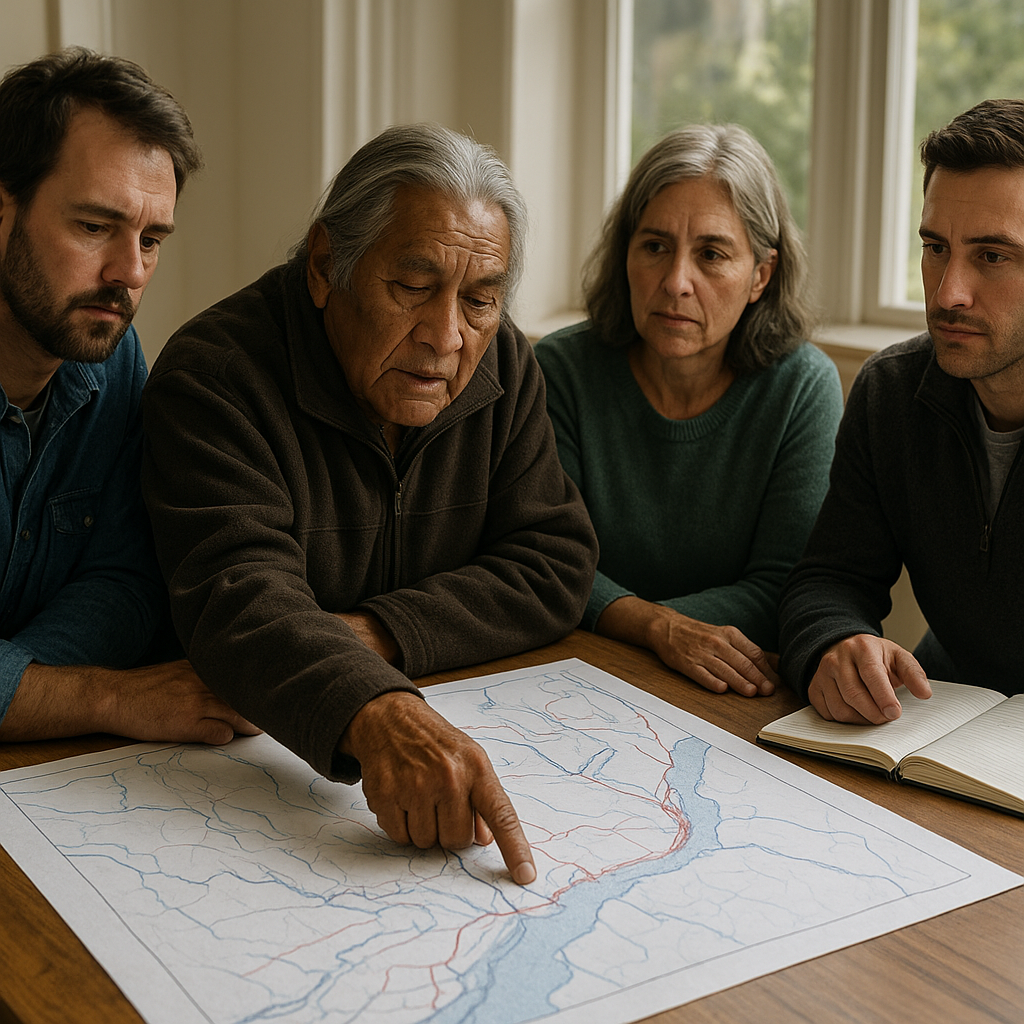
Information and authority go hand in hand. When communities help set priorities, retain control over sensitive knowledge and have the resources to shape implementation, local insight can move from the margins to the centre of climate adaptation. That can make the difference between a plan that looks convincing on paper and one that has a realistic chance of holding up under pressure.