
Introduction
In urban sustainability, the biggest challenge is often not choosing between technologies but adapting a proven idea to local conditions. A city may have a sound plan for cleaner transport, cooler streets or more energy-efficient buildings. The real test is whether it can make that plan work within its budget, institutions and community.
City knowledge exchange helps governments, universities, businesses and residents share practical experience, so each city does not have to start from scratch. But city knowledge exchange is not simply copying. Cities need to understand why a solution worked, then adapt it without losing sight of its purpose.
This matters because sustainable cities are shaped by decisions made over time. A pilot may attract attention, but lasting progress depends on whether its lessons inform procurement, planning, infrastructure and public services after the pilot team moves on. Regular city knowledge exchange can help carry those lessons into the next stage.
Analysis of the teams and players
City governments can set priorities and coordinate departments, but they rarely control every resource involved. Transport agencies, utilities, housing providers and local businesses each have a role. When responsibilities are unclear, even a good proposal can stall between departments. City knowledge exchange gives these teams a practical way to compare responsibilities and share what has worked.
Universities and technical institutions can connect research with practice. They can test assumptions, measure outcomes and explain which parts of a model depend on local conditions. Their work is most useful when it informs decisions, rather than ending as a report with no clear route into policy. In city knowledge exchange, research is most valuable when officials and communities can apply it directly.
Residents are more than an audience for finished plans. They know how streets, services and buildings are used, and they often bear the costs when an intervention does not fit local needs. Early engagement can reveal practical barriers, build trust and improve a programme. Consultation is less effective when the design is already settled. Including residents makes city knowledge exchange more grounded in daily experience.
Intermediaries help these groups work together. Municipal networks, peer-learning partnerships and regional alliances give officials ways to compare successes, failures and methods for measuring results. These connections can make city knowledge exchange an ongoing practice rather than a one-off meeting. Research on knowledge-transfer partnerships shows how collaboration can connect academic expertise with urban practice, as explored in this case study of knowledge exchange for sustainable cities.
Key factors
The first factor is context. A measure that works in one place may depend on powers, funding, climate or public transport options that another city lacks. Before adopting it, officials need to identify what drove the result and which conditions simply made implementation easier. City knowledge exchange is useful when it makes these local differences visible.
This is the central challenge of policy transfer. Cities should borrow principles and evidence, not assume that another jurisdiction’s entire approach will work unchanged. For example, the success of a low-emission transport programme depends not only on its target, but also on street layout, enforcement capacity, travel alternatives and who bears the costs of the transition. City knowledge exchange can help officials separate transferable lessons from place-specific advantages.
The second factor is useful evidence. Shared knowledge should include practical details such as costs, staffing, timelines, procurement hurdles, maintenance needs and unintended effects. Comparable measures matter, but so does an honest account of why a promising pilot missed its target or proved difficult to expand. This kind of detail gives city knowledge exchange lasting value.
Climate solutions also compete for political attention and limited public funds. Timing matters: a street redesign may need to coincide with a utility upgrade, housing investment or scheduled maintenance. City knowledge exchange can reveal these dependencies early and help departments avoid projects that work in isolation but do not support one another.
Third is the ability to adapt during delivery. Cities should set clear goals, establish a baseline and decide how they will review results. If monitoring shows that a measure is not reaching the intended neighbourhoods or reducing emissions as expected, officials need the authority and public trust to change course. Sharing these adjustments through city knowledge exchange helps others learn from implementation, not only from outcomes.
Finally, knowledge must outlast staff changes and funding cycles. Personal relationships can start collaboration, but lasting exchange requires clear responsibilities, accessible records, ongoing training and funding for evaluation. Without that support, expertise leaves with the project team, and the city may have to relearn lessons already learned elsewhere. Strong city knowledge exchange depends on keeping those lessons accessible.
Match scenario
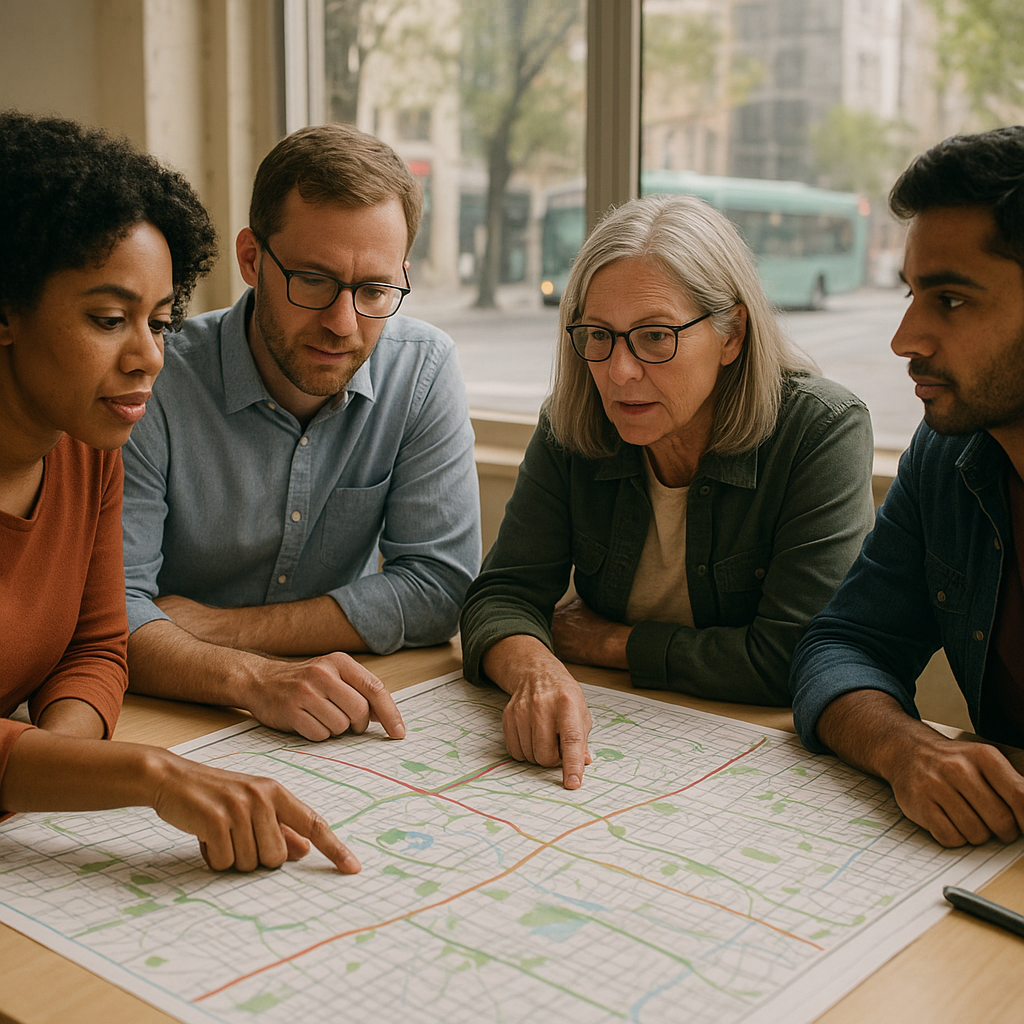
Imagine a municipality aiming to reduce heat and improve access to public space. It studies another city’s street-cooling programme, then brings together planners, public-health researchers, transport officials, local businesses and residents before choosing a design. The existing programme offers a starting point, not a fixed plan. This is city knowledge exchange in practice: learning from another place while shaping the response locally.
First, the city maps areas with the greatest heat exposure and considers how changes could affect deliveries, bus routes, disability access and nearby homes. A small trial allows the team to test materials and maintenance needs in real conditions. Throughout the process, the team compares local observations with evidence from the original programme and revises the design where conditions differ.
The second phase tests whether the city can build on the pilot. If it succeeds, the municipality must secure funding, coordinate public works and decide who will maintain the improvements. If it struggles, an honest evaluation can still show whether the problem lay in the intervention, the delivery model or the original assumptions. Recording these findings strengthens future city knowledge exchange.
Success is not measured by a press release or by how many cities adopt the same label. It depends on whether the intervention delivers measurable benefits, reaches the people it is intended to serve and can be maintained without undermining other essential services. The lessons will help other cities only if they are recorded clearly enough to share.
Conclusion
Effective knowledge exchange is not about importing a finished playbook. City knowledge exchange helps cities combine evidence with local expertise, adapt solutions and learn before small experiments become expensive commitments.
Cities do not need identical policies to make progress together. They need honest accounts of implementation, practical ways to collaborate and the discipline to distinguish transferable lessons from local advantages. This allows proven ideas to move between places without losing their context—and makes urban sustainability a shared practice rather than a race to claim the first breakthrough. Continued city knowledge exchange can help turn that shared practice into lasting progress.