
Building Peace Through Shared Education and Cross-Border Research Partnerships
Introduction
Peace is often described as an outcome: an agreement reached, a dispute contained, a relationship repaired. But lasting peace also depends on what people learn to do together before and after a crisis. Education and research cannot resolve every political disagreement, but they can give people a place to examine competing accounts, test ideas and build habits of cooperation.
That is the promise of peacebuilding education. It does not remove conflict from public life: disagreement is normal and sometimes necessary. Instead, peacebuilding education helps people engage across differences by listening carefully, investigating evidence and understanding how other communities view the same questions. Cross-border research can put these skills into practice, as long as partners treat it as a shared effort rather than a one-way transfer of expertise. In this way, peacebuilding education can contribute to conflict prevention without pretending that disagreement can or should disappear.
Roles: institutions, educators and students
The field brings together teams with different strengths and responsibilities. Schools and universities provide continuity, curriculum and space for inquiry. Researchers develop methods for asking and testing questions. Educators turn complex ideas into practical learning, while students contribute their own experiences and questions. They should shape the work, not simply receive it. Peacebuilding education is most meaningful when these roles allow everyone to participate actively.
International partnerships work best when everyone has a clear role and a genuine stake in the outcome. If one institution sets the agenda while another provides access or local knowledge, the partnership risks repeating the imbalance it aims to address. Shared decision-making, transparent processes and respect for different kinds of expertise help build trust. This kind of academic collaboration also makes peacebuilding education more responsive to the communities involved.
Bringing people into the same room is not the same as helping them learn from one another. That takes more than a shared syllabus or a joint research project. Participants need chances to compare perspectives, question assumptions and examine how evidence is gathered and interpreted. This shared learning may bring disagreements to the surface rather than resolve them. The important question is whether people can disagree constructively and still have a say in what happens next.
These roles can change. Students may become researchers, educators may learn from community knowledge, and institutions may revise their approach when a partnership reveals an imbalance. Effective collaborations leave room for this kind of change and respond to experience rather than treating the original plan as fixed. Such adaptability is an important part of peacebuilding education.
Key factors
First, trust depends on conduct, not slogans. Partners need clear expectations about who sets research questions, how findings are interpreted and how credit is shared. If these decisions are vague, the most powerful institution may end up defining success for everyone. Making the process transparent lets participants raise concerns before frustration leads them to withdraw.
Second, peacebuilding education requires intellectual openness. Participants should not have to accept one approved account of history or identity. Instead, they should learn to distinguish evidence from assertion, recognise uncertainty and consider why people interpret events differently. This takes skilled facilitators who can keep discussions rigorous without treating all claims as equally well supported or every disagreement as a threat. These practices help make peacebuilding education both credible and inclusive.
Third, research should address questions that matter to the people involved. Cross-border research can compare experiences and show how communities or institutions respond to similar challenges. But comparisons are useful only when they account for context. A model that works in one place cannot simply be copied elsewhere. Partners need to discuss what can be adapted, what cannot and who decides. Careful inquiry like this strengthens peacebuilding education by connecting ideas to local realities.
Fourth, partnerships need continuity. A short exchange can spark curiosity, but relationships take time to develop beyond a single project or group of participants. Sustained work requires institutional commitment, preparation and ways to carry learning forward when people move on. Not every partnership must last indefinitely, but its purpose, limits and next steps should be clear. Ongoing relationships give peacebuilding education a better chance to influence future practice.
Finally, evaluation should go beyond counting activities. A full classroom or completed study shows that work took place, but not whether participants built trust, changed their understanding or became better prepared to work across differences. These outcomes are difficult to measure, and no single measure can capture them fully. Reflection, participant feedback and an honest review of setbacks offer a fuller picture than a polished success story. They can also show whether peacebuilding education is meeting the needs participants identified.
How a partnership can unfold
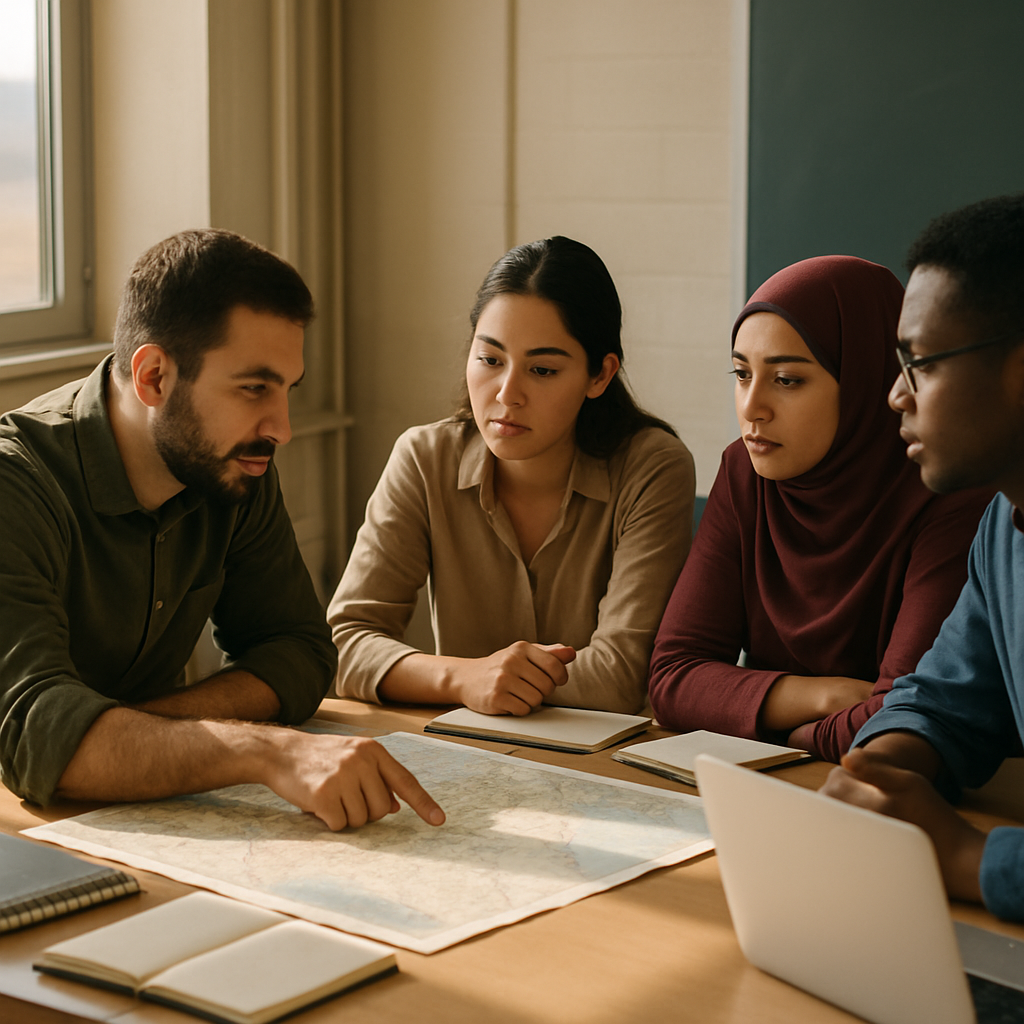
Imagine a joint learning project in which participants from different communities investigate a shared question. The first stage is not a ceremonial kickoff but a careful exchange: participants clarify what they want to learn, where they disagree and what knowledge each person brings. The project is off to a good start not when everyone agrees, but when the group can acknowledge differences without reducing people to them. This is a practical starting point for peacebuilding education.
The middle stage tests the partnership. Teams compare sources, question methods and decide how to interpret their findings. Misunderstandings may arise, and unequal influence may become clear. A strong partnership does not treat these moments as failures. It gives participants ways to pause, revisit decisions and adjust the work while maintaining shared standards of evidence. Through this process, peacebuilding education becomes a practice of working through real challenges together.
The final stage is not a scoreboard declaring victory over conflict. It records what participants learned, what remains unresolved and what they can carry into future work. Stronger research skills, a clearer understanding of other perspectives and relationships that can withstand disagreement are valuable outcomes. A joint publication or report alone means less if the project leaves underlying imbalances untouched. Shared learning and honest reflection help show what peacebuilding education has made possible.
Conclusion
Education and research cannot replace political decisions, public accountability or the difficult work of resolving disputes. Their contribution is more specific: they can help people engage with conflict without giving up on learning from one another. When done carefully, peacebuilding education gives people practice in listening, questioning and cooperating across divides.
The measure of a partnership is not how neatly it describes itself, but how fairly it operates. Cross-border research based on shared responsibility, academic collaboration that respects local knowledge and learning that allows for genuine disagreement can help create conditions for conflict prevention. A classroom or research project cannot guarantee peace. But people can learn and practise the skills needed to build it together, and peacebuilding education can support that work over time.